A professional flooring installation starts long before the finished floor covering is fitted. Whether you’re installing LVT in a domestic property or resilient flooring in a commercial environment, the condition and preparation of the subfloor can have a major impact on the appearance, performance and longevity of the finished floor.
Uneven surfaces, residual adhesive, excessive moisture, movement and poor preparation can all cause problems later. With modern resilient floorcoverings, even relatively small imperfections in the subfloor can become visible through the finished installation.
In many installations, preparation will involve either smoothing a concrete or screeded subfloor with an appropriate smoothing compound, or preparing a timber floor with flooring-grade plywood. Depending on the existing substrate and site conditions, moisture control systems, primers and repair products may also be required.
The principle is straightforward: the finished floor can only be as good as the surface beneath it.
In this Salesmark West Explains guide, we look at the fundamentals of subfloor preparation, common problems to watch for and the steps that help create a clean, dry, smooth, level, strong and suitable surface ready for flooring.
Why Subfloor Preparation Matters
A successful flooring installation starts with the subfloor. Before installing LVT or commercial resilient flooring, the installer needs a surface that provides a stable, consistent foundation for the finished floor covering.
Preparation is particularly important with resilient flooring. Unlike carpet, which can disguise minor variations in the surface beneath it, LVT and other resilient floor coverings can highlight imperfections. Ridges, joints, damaged areas and other irregularities may ultimately affect the appearance or performance of the finished installation.
Taking time to assess and correctly prepare the subfloor at the beginning of the job can help avoid remedial work later. In many installations this means preparing a concrete or screeded floor with an appropriate smoothing compound, or overlaying a suitable timber subfloor with flooring-grade plywood.
Depending on the substrate and site conditions, the preparation system may also require primers, moisture-control products or specialist repair products.
The principle is simple: the finished floor can only be as good as the surface beneath it.
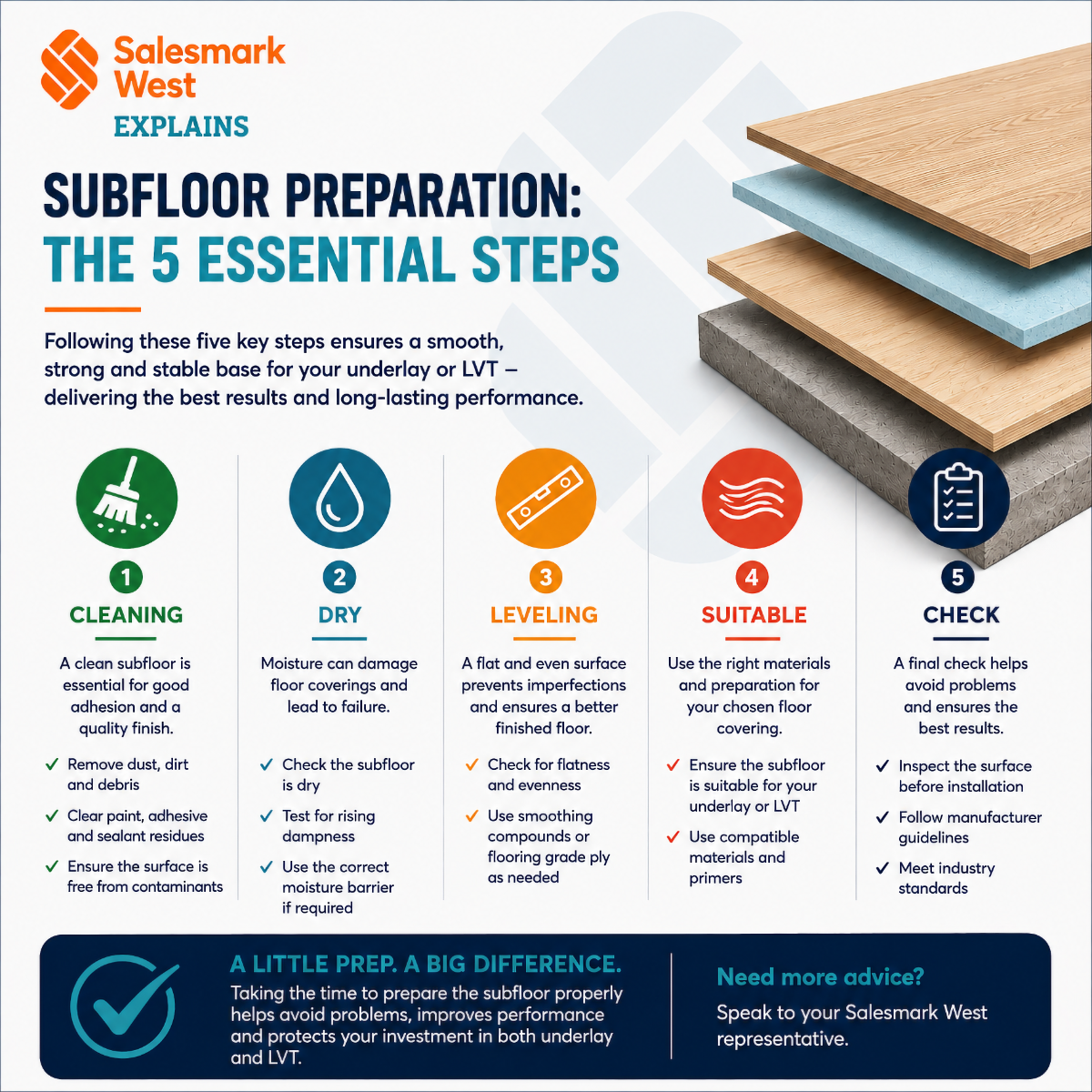
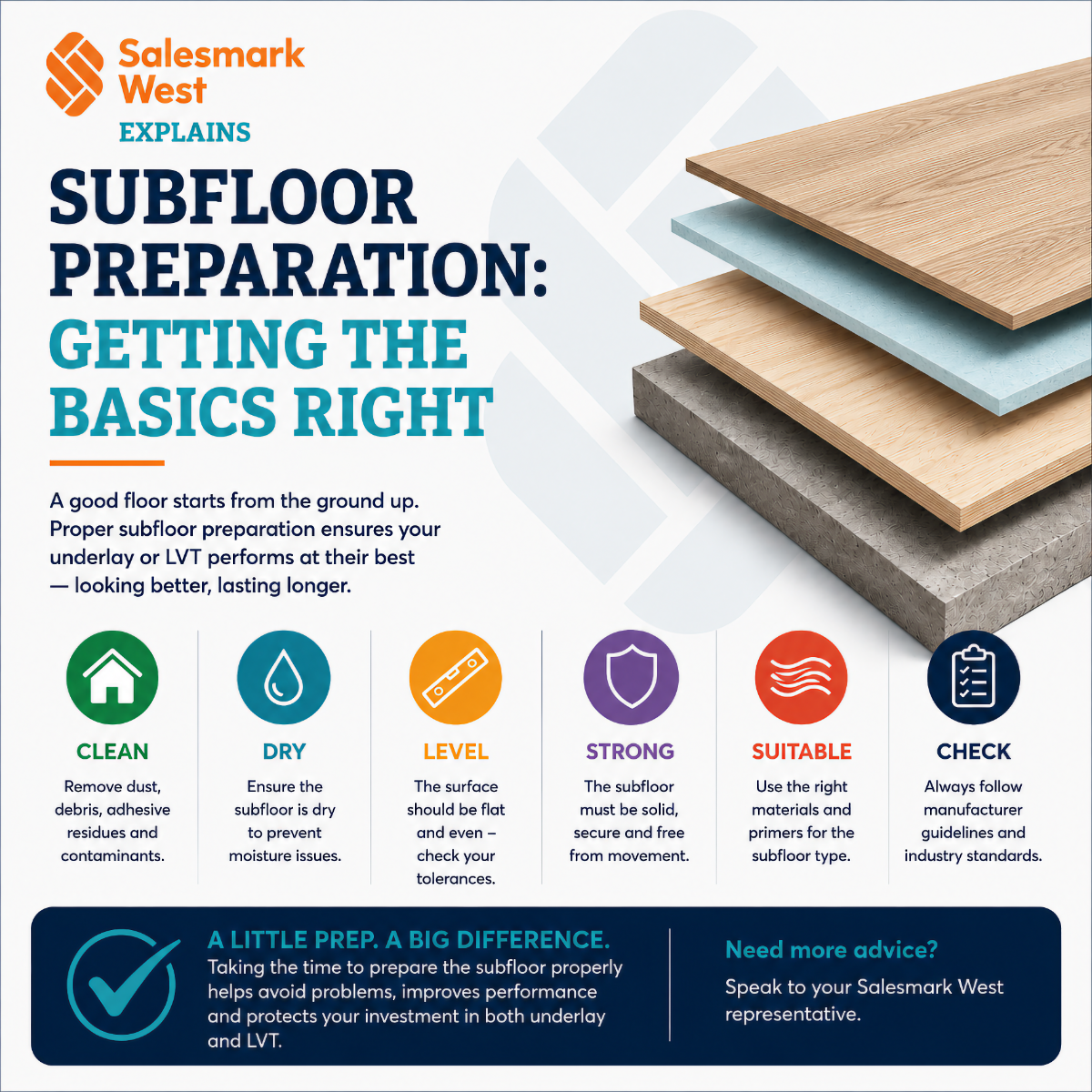
The Basics: Clean, Dry, Smooth, Strong and Suitable
There isn't one preparation method that works for every floor. The correct approach depends on the substrate, its condition, the floor covering being installed, and the products being used.
However, there are several basic principles that apply to virtually every installation. The subfloor needs to be clean, dry, smooth, flat, strong, stable and suitable for the flooring system being installed.
1. Start with a Clean Subfloor
Dust, dirt, grease, paint, plaster, old adhesive residues and other contaminants can interfere with primers, smoothing compounds and flooring adhesives.
The surface should therefore be thoroughly assessed and cleaned before preparation products are applied. Simply covering contamination with smoothing compound isn't a substitute for proper preparation.
The objective is a clean, sound surface to which the subsequent preparation system can properly bond.
2. Make Sure It's Dry
Moisture is one of the most important considerations when preparing concrete and screeded subfloors.
A floor can appear perfectly dry on the surface yet still contain enough moisture to cause problems beneath an impervious floor covering.
The subfloor should therefore be assessed and, where required, tested using an appropriate method before installation begins.
If moisture levels are too high for the intended flooring system, an appropriate damp-proof membrane (DPM) or moisture-management system may be required before further preparation.
Always follow the requirements of the flooring, adhesive, and preparation product manufacturers.
3. Smooth, Flat and Even
With LVT and resilient flooring, the quality of the prepared surface is particularly important.
High spots, depressions, ridges, damaged screed, joints, and other irregularities can affect the appearance of the completed floor and may become visible through the floor covering.
On suitable concrete and screeded substrates, an appropriate smoothing compound is commonly used to produce a smooth, consistent surface ready for flooring installation.
Smoothing compounds aren't simply there to make the floor look better. They form an important part of the overall flooring system and need to be selected according to the substrate, expected traffic, required application depth, and subsequent floor covering.
Preparing Timber Subfloors
Timber floors present a different set of challenges. Floorboards can move independently, joints may be visible, and the existing surface may not provide the smooth, stable base required for LVT or other resilient flooring.
Where appropriate, flooring-grade plywood can be used to overlay and stabilise the existing timber subfloor, creating a more uniform surface for subsequent preparation and installation.
The plywood needs to be suitable for flooring applications and correctly fixed. Particular attention should be paid to board joints, fixings and any movement within the original floor.
Simply laying plywood over an unstable floor won't cure the underlying problem. The original floor must first be sufficiently sound and secure.
Primers: A Small Step That Matters
Primers are sometimes treated as an optional extra, but they can be an essential part of the preparation system.
Depending on the substrate and smoothing compound being used, the correct primer can help:
- Control the absorbency of the substrate
- Improve adhesion
- Reduce pinholing and other surface defects
- Provide compatibility between the substrate and smoothing compound
- Help achieve a more consistent finished surface
The correct primer should always be selected for the specific substrate and preparation system, rather than assuming that a single primer is suitable for every floor.
Check for Movement, Cracks and Damage
Before covering the subfloor, look carefully for signs of movement, contamination or deterioration.
Typical issues include:
- Loose or moving floorboards
- Cracks in screeds or concrete
- Damaged or weak areas
- Open joints
- Loose existing smoothing compound
- Residual adhesive
- Dust, grease or other contamination
- High or low areas in the subfloor
- Excessive moisture
These problems shouldn't simply be hidden beneath the next layer of flooring. The cause should be understood, and the appropriate repair or preparation method should be used before proceeding.
Common Subfloor Preparation Mistakes
Many flooring problems can be traced back to rushed preparation, missed important checks, or the use of an unsuitable product.
Common mistakes include:
- Skipping moisture testing because the floor looks dry
- Applying preparation products over dust or contamination
- Using the wrong primer or omitting one where it is required
- Ignoring movement in timber substrates
- Failing to repair cracks or damaged areas
- Using unsuitable plywood rather than flooring-grade material
- Expecting flooring adhesive to compensate for an uneven subfloor
- Installing before preparation products are ready to receive the floorcovering
Preparation can sometimes seem like the stage of an installation where time can be saved. In practice, skipping the prep can create considerably more work later.
Preparation Solutions: Get the Foundation Right
Different subfloors require different solutions. A typical preparation system might involve one or more of the following:
- Smoothing compounds – for producing a smooth, consistent surface over suitable concrete, screed and other approved substrates
- Flooring-grade plywood – for appropriately overlaying and preparing suitable timber substrates
- Moisture-control systems – where residual or construction moisture needs to be managed
- Primers and adhesion aids – to prepare the substrate for subsequent smoothing compounds and other products
- Repair products – for cracks, joints, damaged areas and localised repairs
These products shouldn't be considered individually. Subfloor preparation is a system, and the products used need to be compatible with the substrate, each other, the flooring adhesive and the final floorcovering.
Prep Today, Better Results Tomorrow
Good preparation takes time, but correcting a failed or visibly poor installation takes considerably longer.
Getting the preparation right can help:
- Reduce the likelihood of remedial work and delays
- Create a smoother and more professional finish
- Improve the performance of the flooring system
- Protect the investment in the finished floor
- Help installations comply with manufacturer requirements
- Reduce callbacks and improve customer satisfaction
For professional flooring contractors, preparation isn't simply the bit before the job. It's an integral part of the job.
Always Check the Specification
Subfloors and site conditions vary enormously, so there is no universal preparation specification.
Always check the technical requirements of the floorcovering, smoothing compound, primer, moisture-control system and adhesive being used, including preparation requirements, application depths, drying or curing times and substrate compatibility.
Need Advice on Subfloor Preparation?
Salesmark West supplies a comprehensive range of floor preparation products, smoothing compounds, primers, moisture-control systems, flooring-grade plywood and flooring adhesives.
If you're unsure which preparation system is suitable for a particular installation, speak to the Salesmark West team. Please tell us what the existing subfloor is, what you're installing over it, and which floor covering you're fitting, and we'll help you identify the appropriate products for the job.
Subfloor Preparation Explained