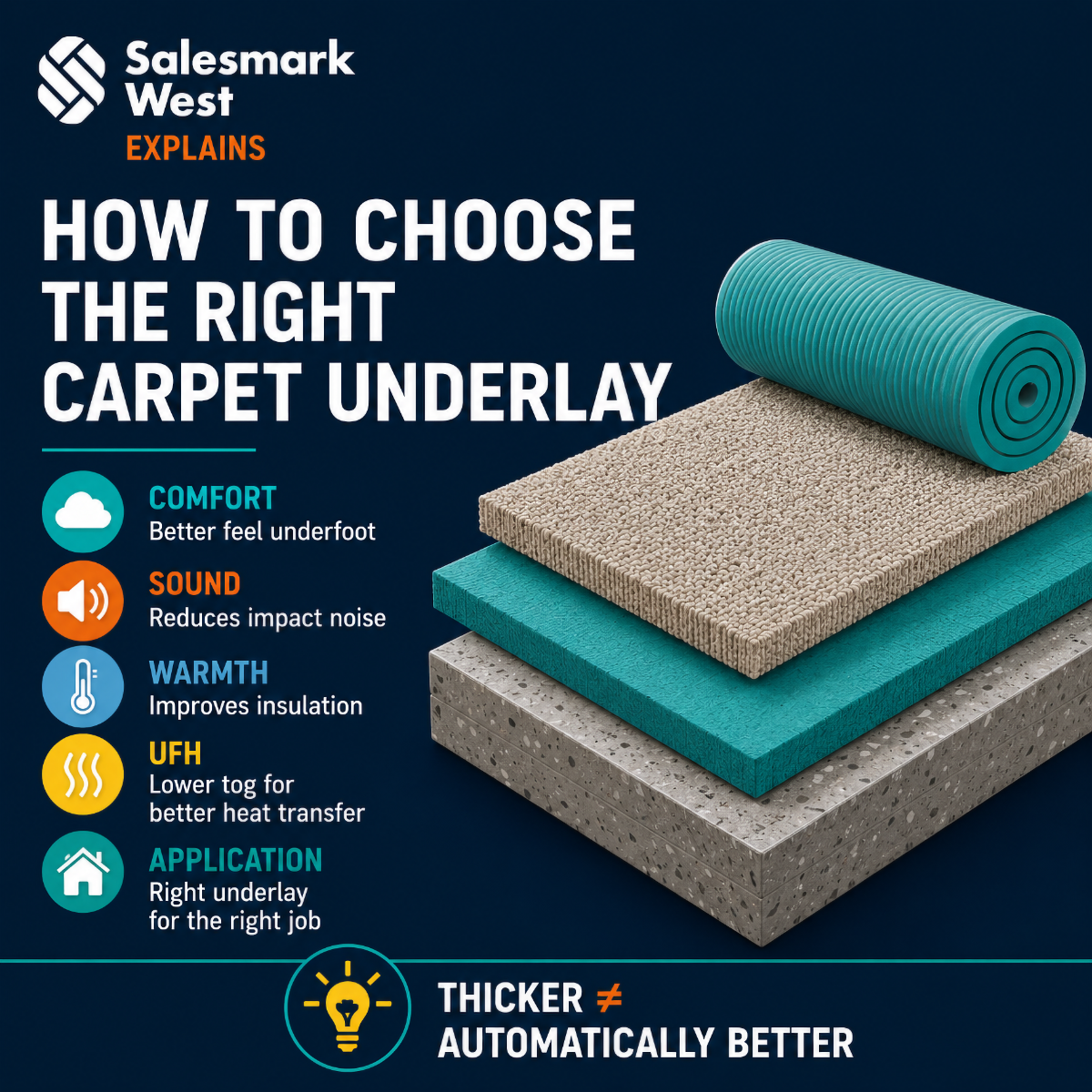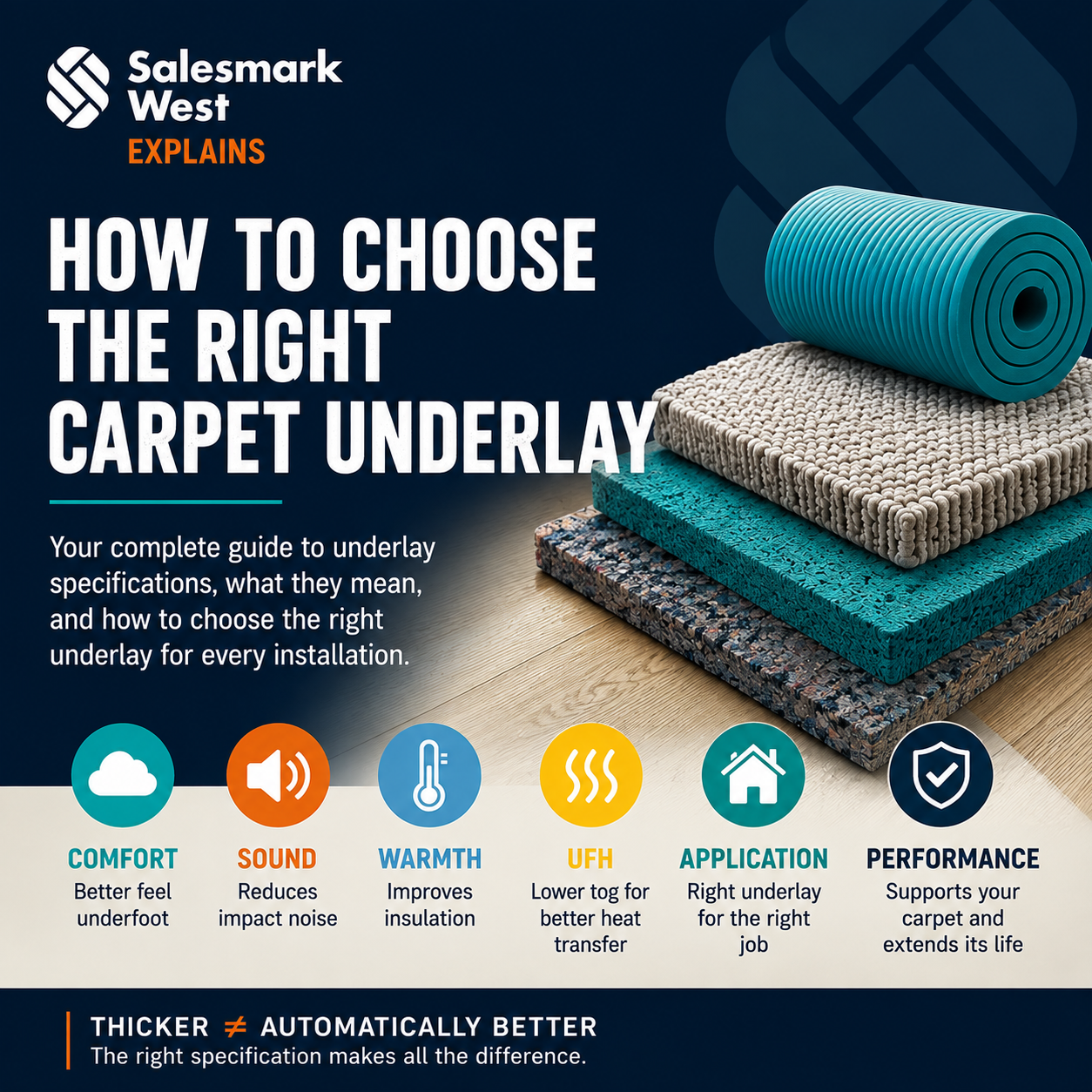
Carpet underlay can sometimes be treated as an afterthought, but choosing the right underlay can make a significant difference to both the immediate feel and the long-term performance of a carpet installation.
A good underlay does far more than make a carpet feel softer underfoot. Depending on its construction and specifications, it can provide additional support for the carpet, reduce impact sound, improve thermal insulation, and help the carpet withstand the stresses of everyday use. Choosing the right underlay can therefore contribute to the comfort, appearance and longevity of the finished floor.
However, there isn’t one underlay that’s right for every job. A luxurious bedroom carpet has very different requirements from a busy hallway or staircase, while an installation over underfloor heating requires particular attention to thermal resistance. Contract and other high-traffic installations introduce further considerations around density, resilience and durability.
With underlays available in different materials, thicknesses, densities, tog ratings, and acoustic specifications, it’s easy to focus on a single figure – particularly thickness – when the overall specification is what really matters.
In this Salesmark West Explains guide, we look at the key underlay specifications, explain what terms such as tog, dB, thickness and density actually mean, and help you identify the right type of underlay for different carpet installations.
How to Choose the Right Carpet Underlay
Carpet underlay can sometimes be treated as an afterthought, but choosing the right underlay can make a significant difference to both the immediate feel and the long-term performance of a carpet installation.
A good underlay does far more than make a carpet feel softer underfoot. Depending on its construction and specifications, it can provide additional support for the carpet, reduce impact sound, improve thermal insulation, and help the carpet withstand the stresses of everyday use. Choosing the right underlay can therefore contribute to the comfort, appearance and longevity of the finished floor.
However, there isn't one underlay that's right for every job. A luxurious bedroom carpet has very different requirements from a busy hallway or staircase, while an installation over underfloor heating requires particular attention to thermal resistance. Contract and other high-traffic installations introduce further considerations around density, resilience and durability.
With underlays available in different materials, thicknesses, densities, tog ratings, and acoustic specifications, it's easy to focus on a single figure, particularly thickness, when the overall specification is what really matters.
In this Salesmark West Explains guide, we look at the key underlay specifications, explain what terms such as tog, dB, thickness and density actually mean, and help you identify the right type of underlay for different carpet installations.
What does carpet underlay actually do?
Underlay creates a resilient layer between the carpet and the subfloor. Depending on the type and specification, a good underlay can help to:
- Improve comfort and cushioning underfoot
- Reduce impact sound from footsteps and movement
- Provide additional thermal insulation
- Support the carpet and help reduce excessive wear
- Help absorb some of the stresses created by everyday foot traffic
- Improve the overall feel of the finished installation
- Help compensate for minor imperfections in the subfloor
The required balance between these benefits will vary from one installation to another. A luxury bedroom, a busy staircase, a rental property, and a home with underfloor heating may all require very different underlays.
Thickness – is thicker underlay always better?
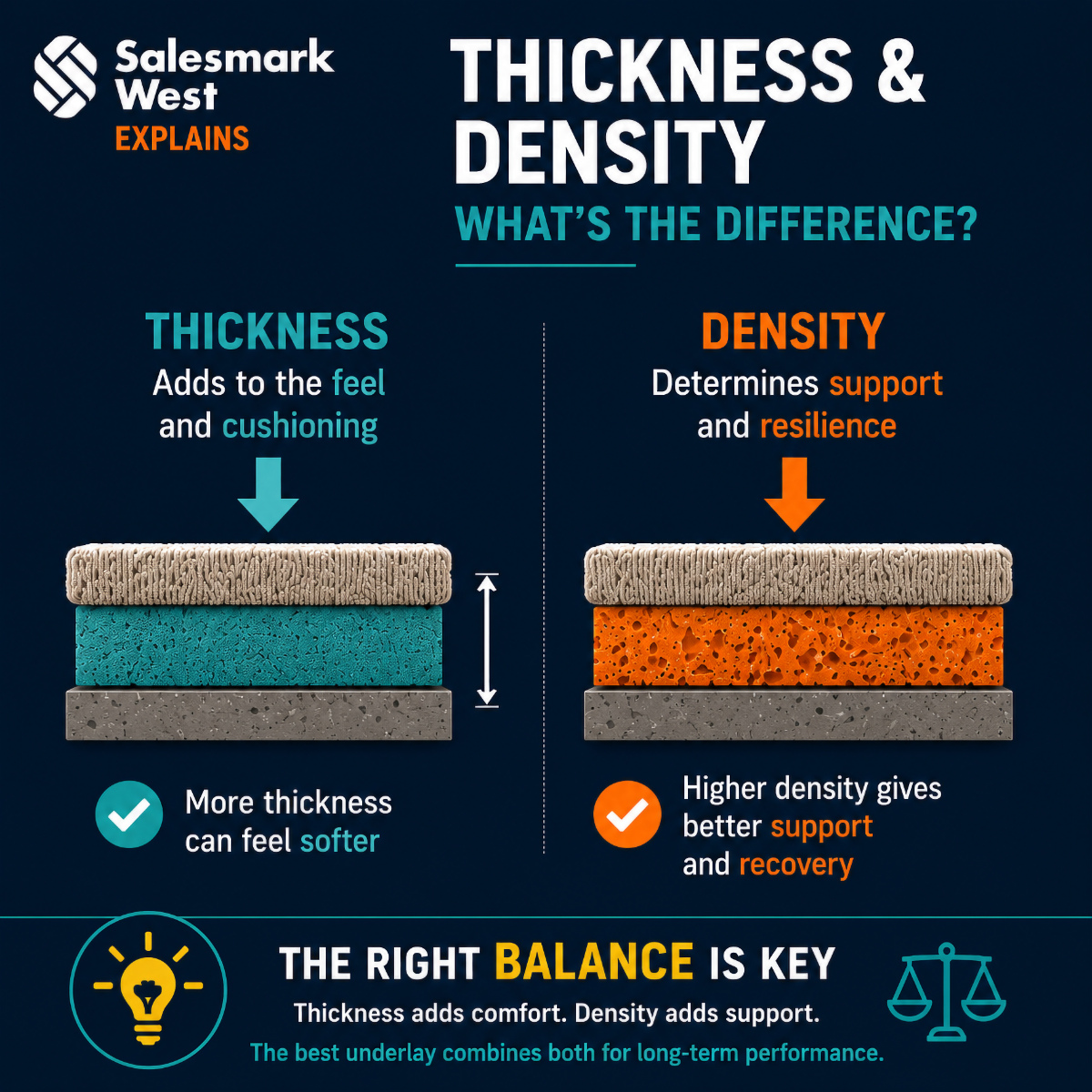
No. Thicker does not automatically mean better.
Thickness contributes to the feel of an underlay. Still, two underlays of similar thickness can perform very differently because their construction, density, and ability to recover after compression may differ.
A thicker, softer underlay can provide a luxurious feel when used correctly. At the same time, a firmer and denser product may be more appropriate where greater support or resistance to repeated traffic is required.
The complete specification should therefore be considered rather than choosing an underlay based solely on thickness.
Density – why does it matter?
Density helps determine how supportive and resilient an underlay feels. An underlay needs to compress when walked on and then recover.
If an underlay is too soft for the application, excessive movement can place additional stress on the carpet. Higher-density products can provide greater support and resistance to compression, making density particularly relevant in demanding domestic areas and under heavier traffic.
Think about how the room will actually be used, rather than choosing purely on how soft the underlay feels when squeezed by hand.
Tog rating – warmth versus heat transfer
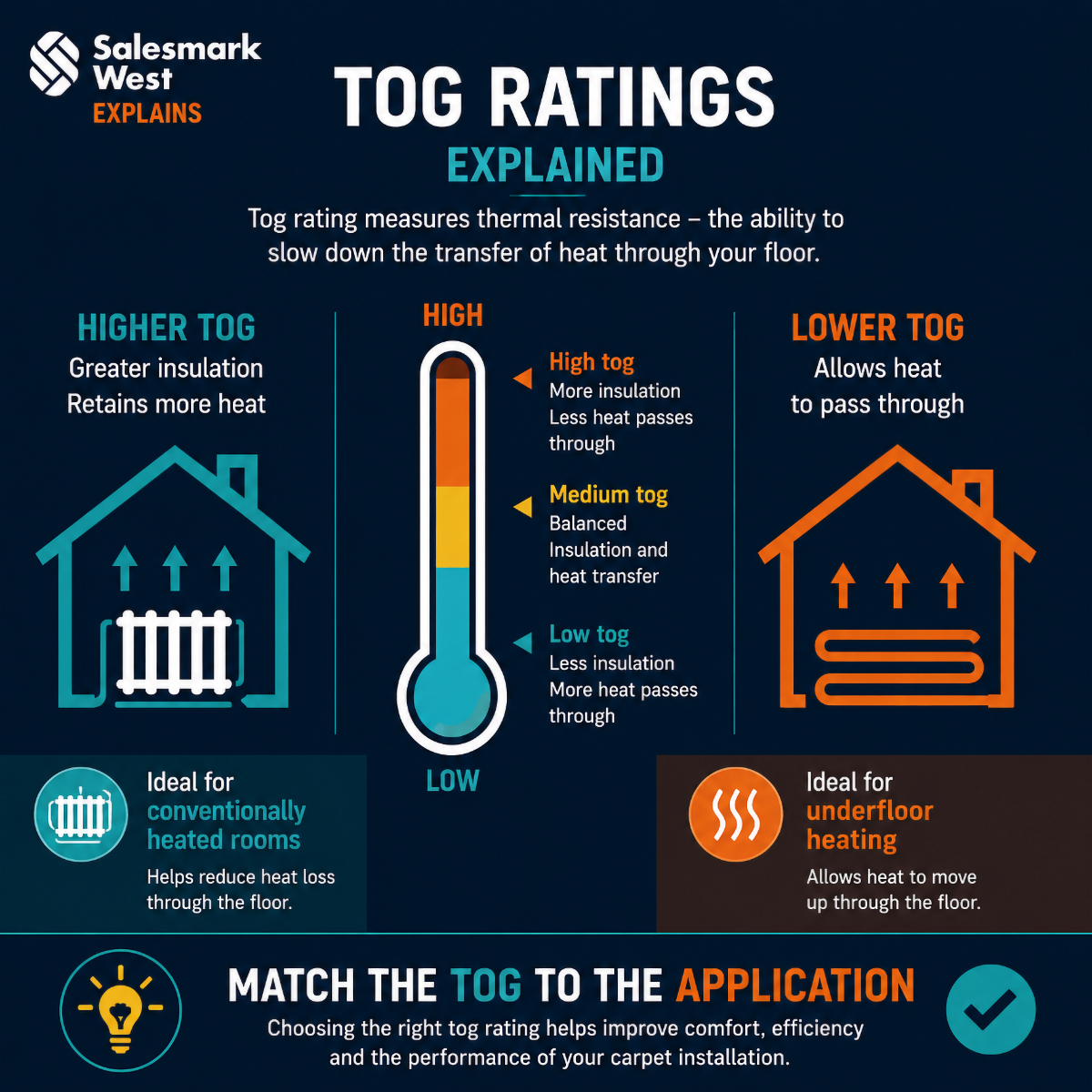
The tog rating measures thermal resistance. Put simply:
Higher tog = greater resistance to heat passing through.
For a conventionally heated room, additional thermal insulation can be beneficial by reducing heat loss through the floor.
Underfloor heating creates a different requirement. When heat needs to travel upwards through the floor covering, a lower thermal resistance is generally desirable. The combined thermal resistance of the underlay and floor covering must therefore be considered and should be suitable for the particular underfloor heating system.
This is why an underlay designed specifically for underfloor heating can be a better choice than a conventional thick underlay.
For installations over underfloor heating, Floorwise Thermaflow Impact is specifically designed for this application. With a low 0.79 tog rating, it allows heat to transfer efficiently through the floor while also providing 34dB impact sound reduction.
What does the dB rating on underlay mean?
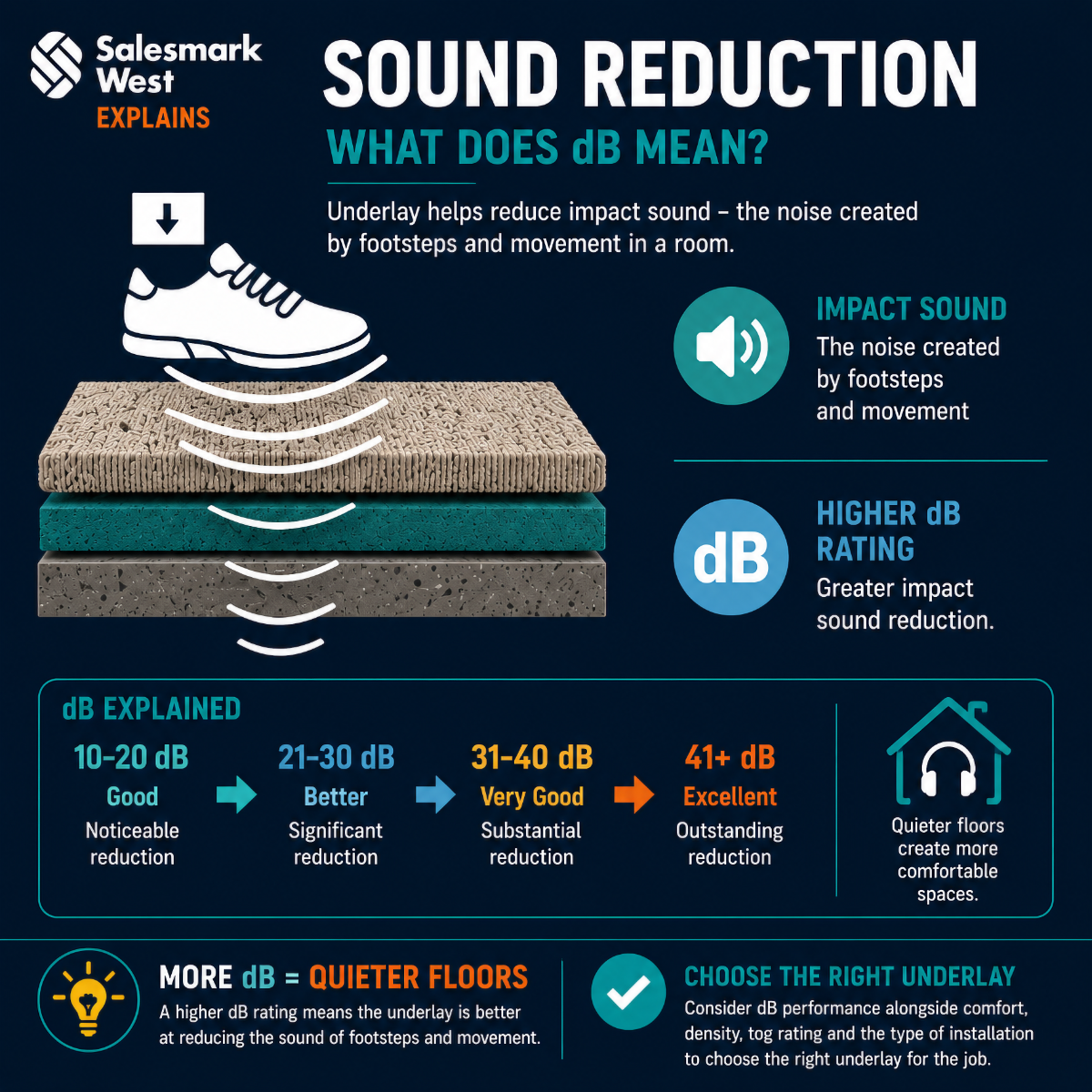
Underlay can also help reduce impact sound – noise generated by movement such as footsteps.
Acoustic performance is normally expressed as a reduction measured in decibels (dB). As a general principle, a higher quoted impact sound reduction indicates better acoustic performance under the conditions under which the product was tested.
This can be particularly useful in:
- Bedrooms
- Upstairs rooms
- Flats and apartments
- Family homes
- Areas where reducing footfall noise is important
It is important to compare products on a like-for-like basis and consider any specific acoustic requirements of the project.
PU foam or sponge rubber underlay?
There is no single construction that is automatically right for every installation. Both PU foam and sponge rubber underlays have their place, and the choice should be based on the specification and intended application.
PU foam underlay
PU foam underlays are widely used for domestic carpet installations and are available in a broad range of thicknesses and densities.
- Low weight and easy handling
- Good comfort
- Good thermal performance
- Useful acoustic performance
- A wide choice of specifications for different applications
Sponge rubber underlay
Sponge rubber has been successfully used beneath carpet for many years and remains an excellent choice for many installations.
- A firm, supportive feel
- Good resilience
- Strong acoustic performance depending on specification
- Different constructions for different installation requirements
The decision should be based on the individual product specification and intended application, rather than material alone.
Choosing underlay for different applications
General domestic use
For bedrooms, lounges, and other typical domestic areas, look for a good balance of comfort, support, thermal performance, and value. There is rarely a need to choose purely on the highest specification available.
For everyday domestic installations, Floorwise Foundation 8 is a dependable, general-purpose carpet underlay that provides a comfortable, supportive foundation for the carpet while offering a good balance of performance and value.
Luxury domestic installations
For premium carpets and rooms where comfort is particularly important, a thicker or higher-specification underlay can significantly enhance the finished feel. Support and recovery remain important – luxury shouldn't simply mean soft.
Where a more luxurious feel and higher level of performance are required, Floorwise Supreme 11mm is a good example of a premium underlay. Its 11mm Super High Density Plus (SHD+) construction provides excellent comfort underfoot, while a 2.94 tog rating offers high thermal insulation, and 43dB impact sound reduction helps reduce noise. Classified for Luxury Use (L/U), it is suitable for both residential and commercial installations.
Stairs, hallways and busy areas
These areas experience repeated concentrated traffic. Look for an underlay that offers good support, resilience, and suitability for the expected level of use.
Underfloor heating
Choose an underlay specifically designed for underfloor heating, and pay particular attention to its thermal resistance. Remember that the carpet and underlay work together as a system, so the combined thermal resistance needs to be considered.
For installations over underfloor heating, Floorwise Thermaflow Impact is specifically designed for this type of application. With a low 0.79 tog rating, it allows heat to transfer efficiently through the floor while still providing 34dB impact sound reduction. This makes it an excellent example of why choosing the right underlay specification is more important than simply choosing the thickest underlay available.
Contract and heavy-duty installations
Commercial and demanding installations can have very different requirements from a normal domestic room. Traffic levels, installation method, carpet specification, fire performance and project requirements may all influence the choice of underlay.
For demanding contract installations, Floorwise PowerForce 6.5 is specifically designed for high-traffic commercial environments. Its extremely high-density construction provides excellent stability and resilience, while its Class 33 Heavy Contract Use classification makes it suitable for demanding installations. PowerForce 6.5 can be used in both stretch-fit and double-stick installations, making it a particularly versatile choice for applications that require long-term performance and dimensional stability.
Always check that the selected product is suitable for the intended installation.
Five things to check before choosing an underlay
- Where is it being installed?
Bedroom, lounge, stairs, hallway or commercial environment? - How much traffic will it receive?
A lightly used spare bedroom has very different requirements from a busy staircase. - Is comfort or durability the main priority?
Often you need a balance of both. - Is there underfloor heating?
If so, thermal resistance becomes particularly important. - Is acoustic performance important?
If reducing impact noise matters, compare the appropriate dB performance of suitable products.
Don't forget the rest of the installation.
Even the best underlay cannot compensate for poor installation or unsuitable components.
The condition of the subfloor, the quality and type of carpet gripper, and the correct positioning and stretching of the carpet all contribute to the finished result.
Underlay should therefore be considered as one part of the complete flooring system, rather than an isolated product.
Which carpet underlay should I choose?
There isn't one “best” carpet underlay for every job. The best choice is the product that provides the right combination of:
Comfort • Support • Durability • Thermal Performance • Acoustic Performance • Suitability for the Installation
A high-specification luxury underlay might be ideal in one room and completely inappropriate over underfloor heating in another.
Understanding what the figures mean makes it much easier to specify the right product for the job.
Need help choosing the right carpet underlay?
Salesmark West stocks a wide range of carpet underlays for domestic, luxury, contract and underfloor heating applications.
If you're unsure which specification best suits an installation, speak to the Salesmark West team. We can help you compare the options and choose the right underlay for the job.
Carpet Underlay Explained